What Is Agentic AI? A Business Leader's Guide for 2026
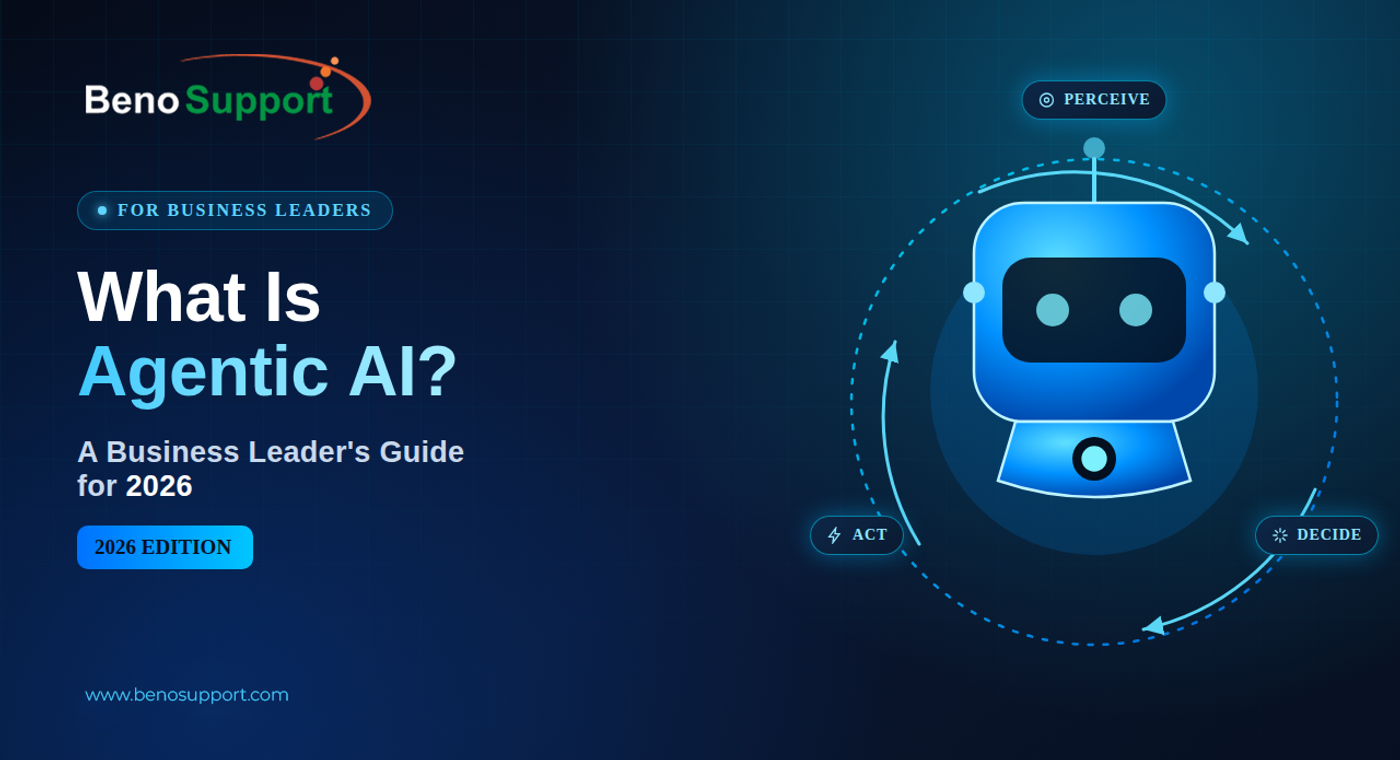
Agentic AI Is Changing How Businesses Operate
Artificial intelligence has already transformed how businesses analyze data, automate workflows, and improve customer experiences. But a new generation of AI is moving beyond responding to prompts or generating content. It's beginning to make decisions, execute complex tasks, collaborate with other systems, and continuously improve outcomes with minimal human intervention.
This evolution is known as Agentic AI.
Unlike traditional AI tools that wait for instructions, Agentic AI systems can understand objectives, plan actions, use multiple tools, adapt to changing situations, and complete multi-step business processes autonomously while keeping humans in control.
For business leaders, this isn't simply another technology trend. It represents a shift from AI as an assistant to AI as an operational workforce.
Organizations across healthcare, financial services, manufacturing, retail, logistics, telecommunications, and professional services are already exploring Agentic AI to reduce operational costs, improve employee productivity, accelerate decision-making, and deliver better customer experiences.
In this guide, we'll explain what Agentic AI is, how it differs from traditional AI, where businesses are using it today, its benefits and challenges, and how organizations can successfully adopt it in 2026.
What Is Agentic AI?
Agentic AI refers to artificial intelligence systems capable of reasoning, planning, making decisions, and executing tasks autonomously to achieve a defined business objective.
Instead of simply generating answers when prompted, Agentic AI can:
- Understand business goals
- Break complex problems into smaller tasks
- Determine the best sequence of actions
- Interact with software applications and APIs
- Learn from outcomes
- Adjust its strategy based on new information
- Request human approval when necessary
Think of Agentic AI as assigning work to a highly capable digital employee rather than asking a chatbot a question.
For example:
Traditional AI helps write an email.
Agentic AI identifies overdue invoices, drafts reminder emails, updates your CRM, schedules follow-ups, alerts finance teams, and provides management reports—all automatically.
The difference lies in execution, not just intelligence.
How Agentic AI Differs from Traditional AI
Many businesses already use AI-powered chatbots, recommendation engines, predictive analytics, or document summarization tools. These solutions deliver value but usually perform one task at a time.
Agentic AI extends those capabilities by coordinating multiple tasks toward achieving a business objective.
Traditional AI
- Responds to prompts
- Performs individual tasks
- Limited reasoning capabilities
- Mostly reactive
- Requires humans to execute actions
- Typically relies on a single AI model
Agentic AI
- Pursues business goals autonomously
- Executes end-to-end workflows
- Uses multi-step planning and reasoning
- Proactive and adaptive
- Performs execution with human oversight
- Coordinates multiple specialized AI agents
Rather than replacing existing AI, Agentic AI builds upon it to create intelligent systems capable of completing real business operations.
How Agentic AI Works
Although implementations vary, most Agentic AI systems follow a similar lifecycle.
1. Understanding the Objective
The AI first interprets the desired business outcome.
Examples include:
- Reduce customer response time
- Approve eligible insurance claims
- Process employee onboarding
- Optimize delivery schedules
- Detect fraudulent transactions
Rather than focusing on one action, it understands the overall objective.
2. Planning
The AI creates a strategy by breaking the objective into manageable tasks.
For example, onboarding a new employee may involve:
- Creating user accounts
- Ordering equipment
- Scheduling orientation
- Sending policy documents
- Updating HR systems
3. Tool Selection
The AI identifies which applications it needs to use, such as:
- CRM
- ERP
- HRMS
- Email platforms
- Databases
- Internal knowledge bases
- APIs
- Collaboration tools
4. Execution
The AI performs the necessary tasks automatically while monitoring progress.
If unexpected situations occur, it adapts its approach or escalates the issue to a human.
5. Continuous Learning
After completing tasks, the AI evaluates outcomes and uses feedback to improve future performance.
Over time, workflows become faster, more accurate, and more efficient.
Why Businesses Are Investing in Agentic AI
Business leaders face increasing pressure to do more with fewer resources.
Organizations today struggle with:
- Rising operational costs
- Talent shortages
- Increasing customer expectations
- Growing cybersecurity risks
- Regulatory complexity
- Manual workflows
- Data silos
- Legacy systems
Agentic AI addresses these challenges by automating not only repetitive tasks but also decision-driven business processes.
Instead of hiring additional teams to manage growing workloads, businesses can scale operations intelligently while maintaining governance and human oversight.
Real Business Applications of Agentic AI
Customer Service
Agentic AI can manage complete customer journeys.
Instead of simply answering FAQs, it can:
- Verify customer identity
- Access order information
- Process refunds
- Schedule appointments
- Escalate complex cases
- Update CRM records
- Send follow-up communications
Customers receive faster resolutions while support teams focus on higher-value interactions.
Financial Services
Banks and financial institutions are using Agentic AI for:
- Loan application processing
- Fraud investigation
- Compliance reporting
- Customer onboarding
- Credit risk analysis
- Payment dispute management
- Portfolio monitoring
Multiple AI agents collaborate across departments while maintaining audit trails and regulatory controls.
Healthcare
Healthcare organizations can automate administrative workloads including:
- Prior authorization
- Patient scheduling
- Claims processing
- Medical documentation
- Appointment reminders
- Insurance verification
Reducing administrative burden allows clinicians to spend more time on patient care.
Human Resources
HR teams can automate:
- Candidate screening
- Interview scheduling
- Employee onboarding
- Benefits enrollment
- Compliance documentation
- Learning recommendations
This improves employee experience while reducing manual effort.
Supply Chain
Manufacturers and logistics companies use Agentic AI for:
- Inventory optimization
- Supplier coordination
- Shipment tracking
- Demand forecasting
- Warehouse operations
- Procurement approvals
These capabilities improve operational resilience and reduce delays.
IT Operations
Technology teams increasingly use Agentic AI to:
- Detect incidents
- Troubleshoot systems
- Restart services
- Generate documentation
- Manage cloud resources
- Prioritize security alerts
This helps reduce downtime while improving operational efficiency.
Key Benefits of Agentic AI
Increased Productivity
Employees spend less time on repetitive administrative work and more time on strategic activities requiring creativity and judgment.
Faster Decision-Making
AI agents process large volumes of information in seconds, enabling quicker operational decisions.
Lower Operating Costs
Automating end-to-end workflows reduces labor-intensive manual processes while minimizing errors and rework.
Improved Customer Experience
Customers receive faster, more personalized, and more consistent service across channels.
Better Business Agility
Organizations can rapidly adapt workflows to changing market conditions without extensive manual intervention.
Enhanced Employee Satisfaction
Rather than replacing employees, Agentic AI removes repetitive work, allowing teams to focus on innovation, relationship building, and strategic initiatives.
Challenges Businesses Must Address
Despite its potential, successful adoption requires careful planning.
Data Quality
AI performs only as well as the information available.
Organizations should invest in clean, accurate, and governed data.
Governance
Businesses need clear policies covering:
- Decision approval
- Human oversight
- Data privacy
- Risk management
- Regulatory compliance
Integration
Many organizations operate multiple legacy applications.
Agentic AI should integrate seamlessly with existing technology ecosystems instead of creating additional silos.
Security
AI agents often access sensitive systems and business data.
Strong cybersecurity, identity management, access controls, and monitoring are essential.
Change Management
Employees need training and confidence to work alongside AI systems.
Successful transformation combines technology with organizational readiness.
Is Agentic AI Replacing Employees?
One of the biggest misconceptions is that Agentic AI exists to eliminate jobs.
In reality, most organizations use Agentic AI to augment human capabilities, not replace them.
AI excels at:
- Repetitive tasks
- Large-scale analysis
- Continuous monitoring
- Process automation
Humans remain essential for:
- Strategic decisions
- Ethical judgment
- Relationship management
- Innovation
- Leadership
- Complex problem solving
The future workforce will increasingly consist of humans collaborating with intelligent AI agents.
How to Prepare Your Business for Agentic AI
Businesses don't need to automate everything at once.
A phased approach delivers better outcomes.
Identify High-Value Processes
Focus on workflows that are:
- Repetitive
- Time-consuming
- Rules-based
- Data-intensive
These typically generate the fastest return on investment.
Strengthen Your Data Foundation
Ensure business data is:
- Accurate
- Secure
- Accessible
- Well-governed
Reliable data enables better AI performance.
Modernize Technology
Evaluate whether your CRM, ERP, cloud infrastructure, APIs, and internal systems can support intelligent automation.
Start Small
Begin with a pilot project that demonstrates measurable value before expanding across departments.
Measure Business Outcomes
Track metrics such as:
- Cost savings
- Productivity improvements
- Customer satisfaction
- Employee efficiency
- Process completion time
- Error reduction
These insights help guide future AI investments.
How to Choose the Right Technology Partner
Implementing Agentic AI requires more than selecting an AI model. Success depends on integrating AI into your business processes, existing applications, data ecosystem, and governance framework.
An experienced implementation partner can help organizations:
- Identify high-impact automation opportunities
- Design scalable AI architectures
- Integrate AI with enterprise systems
- Build secure, governed AI workflows
- Ensure regulatory compliance
- Optimize performance over time
If your organization is exploring intelligent automation, working with specialists in Agentic AI implementation and enterprise automation can significantly reduce risk while accelerating time-to-value.
At Beno Support, we help organizations design and implement secure, scalable AI solutions tailored to real business challenges. Our Agentic AI & Intelligent Automation services combine AI strategy, workflow orchestration, enterprise integration, governance, and automation to help businesses improve efficiency, enhance customer experiences, and drive measurable outcomes. Learn more about our Agentic AI & Intelligent Automation services: https://www.benosupport.com/services/agentic-ai-intelligent-automation
The Future of Agentic AI
As AI models become more capable and enterprise platforms mature, Agentic AI will move beyond isolated automation projects to become an integral part of everyday business operations.
In the coming years, organizations can expect AI agents to:
- Collaborate across departments
- Coordinate complex business workflows
- Support executive decision-making
- Optimize operations in real time
- Deliver increasingly personalized customer experiences
- Continuously learn from business outcomes
Businesses that invest early in governance, data quality, cloud infrastructure, and intelligent automation will be better positioned to compete in an increasingly AI-driven economy.
Final Thoughts
Agentic AI marks the next evolution of enterprise intelligence. Rather than simply assisting employees with isolated tasks, it enables organizations to automate entire workflows, make faster decisions, and scale operations with greater efficiency and control.
For business leaders, the opportunity lies not in replacing people but in empowering teams with intelligent systems that handle routine work, accelerate execution, and unlock new levels of productivity.
Organizations that begin building the right data foundations, governance frameworks, and AI capabilities today will be better equipped to compete, innovate, and deliver exceptional customer experiences in 2026 and beyond.
Frequently Asked Questions (FAQs)
What is Agentic AI in simple terms?
Agentic AI is artificial intelligence that can independently plan, make decisions, and complete multi-step tasks to achieve a business goal while operating within defined rules and human oversight.
How is Agentic AI different from Generative AI?
Generative AI primarily creates content such as text, images, or code in response to prompts. Agentic AI goes further by planning actions, interacting with software, executing workflows, and adapting to changing conditions to accomplish objectives.
Which industries benefit most from Agentic AI?
Industries with complex workflows and large volumes of operational data—such as healthcare, financial services, manufacturing, retail, logistics, telecommunications, insurance, and technology—can achieve significant efficiency gains through Agentic AI.
Is Agentic AI safe for enterprises?
Yes, when implemented with strong governance, cybersecurity, access controls, monitoring, and human oversight. Responsible implementation is essential to ensure compliance, transparency, and risk management.